

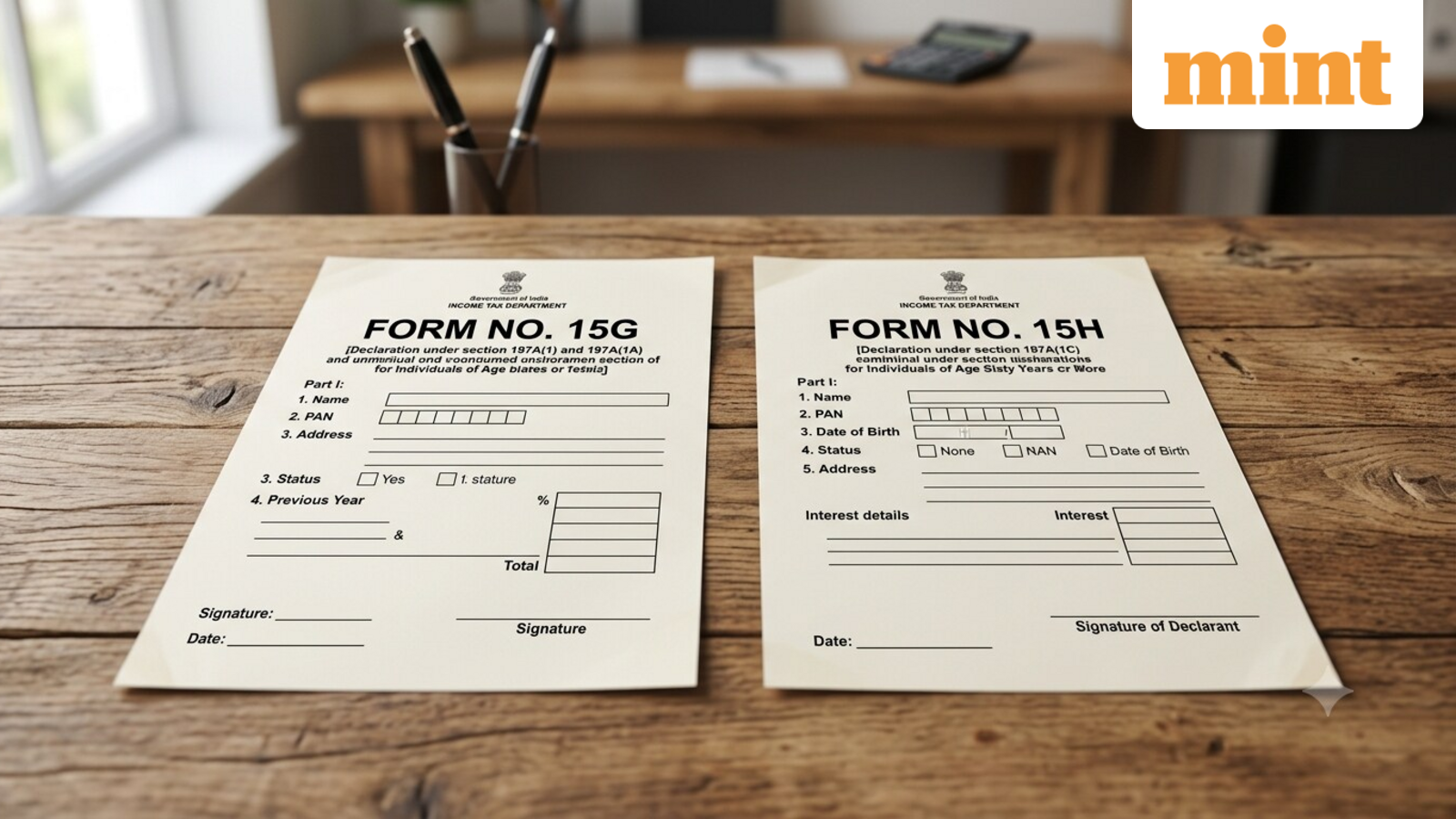
Tax Deducted at Source (TDS) on interest income can reduce the amount credited to your bank account even when your total income in a financial year is not taxable. To prevent unnecessary TDS deductions, the Income Tax Department allows eligible taxpayers to submit self-declaration forms to banks and other financial institutions.
Two such forms are Form 15G and Form 15H, which help taxpayers receive interest income without TDS deduction.
So, let’s understand the difference between Form 15G and Form 15H, eligibility conditions, and how to choose the right form.
Understanding Form 15G
Form 15G is a self-declaration form meant for resident individuals below 60 years of age and Hindu Undivided Families (HUFs). By submitting this form, the taxpayer declares that their total income is below the taxable limit and that no tax is payable for the financial year.
The primary purpose of Form 15G is to prevent TDS deduction on interest income when the taxpayer does not expect to incur any tax liability.
You are eligible to file Form 15G if:
Understanding Form 15H
Form 15H serves a similar purpose but is specifically designed for senior citizens. It allows eligible individuals aged 60 years or above to receive interest income without TDS deduction.
Senior citizens often rely heavily on fixed deposit income after retirement. Form 15H helps ensure that unnecessary TDS is not deducted when their total tax liability is nil.
You can file Form 15H if:
While both forms are intended to prevent unnecessary TDS deductions, the taxpayer’s age is the primary factor in determining which form should be used.
How to download and submit these forms?
You can download Form 15G and Form 15H through your bank’s online portal, the EPFO platform, or the Income Tax Department’s e-filing portal. You can submit these forms to various deductors, including:
- Banks offering fixed deposits and recurring deposits
- Post offices
- Employees’ Provident Fund Organisation (EPFO)
- Insurance companies
- Companies pay dividends
- Mutual fund houses and other financial institutions
- Tenant
Points to remember before submitting the forms
Before submitting Form 15G or Form 15H, keep the following points in mind:
What if TDS has already been deducted?
If you forgot to submit Form 15G or Form 15H and the bank has already deducted TDS, you can claim the amount as a refund while filing your ITR.
- Check the TDS reflected in Form 26AS or the Annual Information Statement (AIS).
- Report the interest income under the relevant income head in your ITR.
- Claim credit for the TDS already deducted.
- If your final tax liability is lower than the TDS deducted, the excess amount will be refunded by the Income Tax Department.
What is Form 121 in the Income Tax Act, 2025?
Starting from FY 2026-27, Form 15G and Form 15H have been replaced by Form 121 under the Income Tax Act, 2025. The new form serves as a unified self-declaration mechanism for taxpayers who wish to avoid TDS on eligible income when their tax liability is nil.
For FY 2025-26 and earlier years, taxpayers can continue to use Form 15G or Form 15H, depending on their eligibility. However, for FY 2026-27 onwards, eligible taxpayers will need to submit Form 121 instead of either of these forms.
Disclaimer: This is only for informational and educational purposes. Please consult a qualified tax expert for the latest tax laws and regulations.