

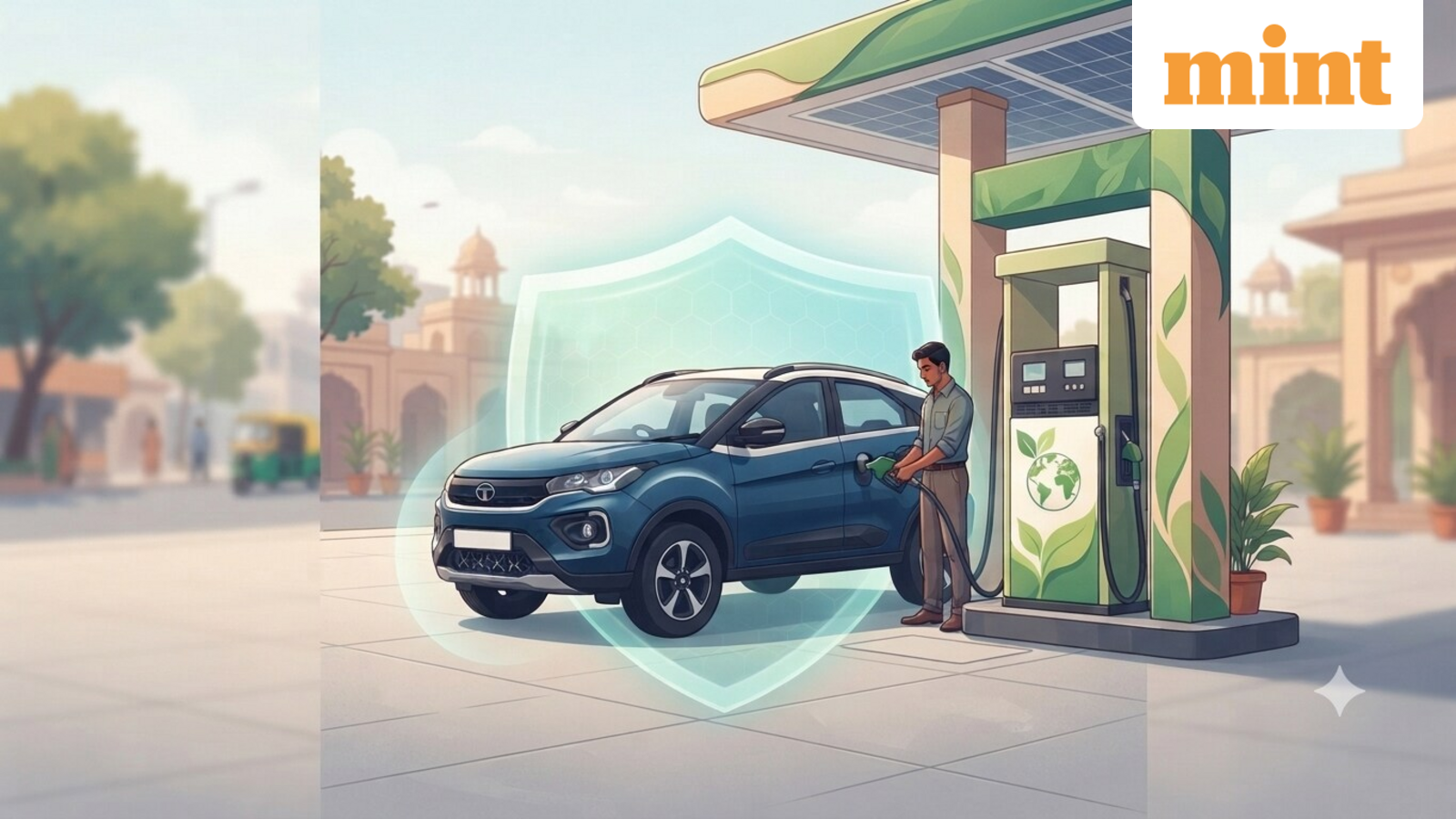
The Ministry of Road Transport and Highways (MoRTH) has amended the Central Motor Vehicles Rules, 1989, to formally recognise E100 alongside E85 for vehicles designed and certified to run on these higher ethanol blends. The amended rules provide a regulatory framework for manufacturers to bring E100-compatible vehicles to the market. However, the approval does not extend to conventional petrol cars or vehicles certified only for E20 fuel.
For buyers, the insurance implications are particularly relevant because fuel compatibility, engine protection and policy exclusions can affect whether a claim is accepted.
The good news is that E100 compatibility alone is not expected to result in higher motor insurance premiums. However, insurers will continue to assess these vehicles based on their design, repair costs and claims experience, industry experts said.
“These are factory-built, regulator-recognised vehicles rather than aftermarket conversions. We therefore see no inherent reason for E100-compatible vehicles to carry any premium loading,” said Amit Agarwal, executive vice-president, retail underwriting (motor and health) and financial assurance, IndusInd General Insurance.
Will E100-compatible cars attract higher motor insurance premiums?
The introduction of E100-compatible vehicles does not automatically mean higher motor insurance premiums. Insurers consider several factors while pricing a policy, including the vehicle’s make, model, variant, value, repair and replacement costs, safety features and claims experience.
Motor insurance has two components: third-party liability and own-damage cover.
Third-party premiums are determined by rates notified by MoRTH in consultation with the Insurance Regulatory and Development Authority of India (IRDAI). For private cars, these rates are linked to engine capacity.
Own-damage premiums, on the other hand, depend on the insured declared value (IDV), geographical location, cubic capacity, vehicle age and the insurer’s claims experience.
“Insurance pricing depends on various vehicle and risk characteristics, including the vehicle model, value, repair and replacement costs, safety features, claims experience and the coverage selected,” said Pooja Yadav, chief product officer.
As E100-compatible cars become more common, insurers will assess actual repair costs and claims experience to determine whether their risk profiles warrant any pricing changes.
Will E100 cars need a separate insurance policy?
E100-compatible cars are not necessarily expected to fall under a separate motor insurance category. Insurers assess vehicles based on their make, model, variant, fuel type and engine capacity, as recorded in the registration certificate (RC).
The distinction between factory-fitted E100 compatibility and aftermarket modifications is important.
A manufacturer-fitted E100-compatible car, with its fuel specifications correctly recorded in the RC and insurance policy, should not ordinarily require a separate endorsement simply because it can run on E100 fuel.
However, if a car owner installs an aftermarket conversion kit or modifies the vehicle after purchase, the change must be disclosed to the insurer and approved. Failure to disclose material modifications could affect claim admissibility.
Insurers are also likely to assess the underlying accident risk of these vehicles as comparable to that of equivalent petrol models. Any further differentiation in underwriting could emerge once sufficient claims data becomes available.
Will comprehensive insurance cover engine and fuel-related damage?
A comprehensive motor insurance policy does not automatically cover every type of engine or fuel-system damage. Standard policies generally cover accidental damage, theft, fire and natural calamities. Mechanical or electrical breakdown, normal wear and tear and consequential losses are typically excluded, subject to the policy wording.
This distinction is particularly relevant for E100-compatible car owners. Damage caused by using the wrong fuel, contaminated fuel or fuel that the vehicle manufacturer has not approved may not automatically qualify for an insurance claim.
Buyers should examine the policy’s terms, conditions and exclusions before purchasing coverage. They should also check whether an engine protection add-on is available and understand the specific types of damage it covers.
“Customers should not assume that every type of engine or fuel-system damage will automatically be covered under a standard comprehensive motor insurance policy. Coverage for a particular loss will depend on its cause and the applicable policy terms, conditions, exclusions and add-ons,” Yadav said.
What should buyers check before purchasing insurance?
Before purchasing an E100-compatible car, buyers should take a few precautions:
- Verify vehicle details: Ensure the fuel type, variant, registration number, engine and chassis details match the RC and insurance policy.
- Check engine protection: Review whether an engine protection add-on covers eligible engine and fuel-system damage and understand its exclusions.
- Understand fuel-related exclusions: Check how the policy treats damage caused by incorrect, contaminated or manufacturer-unapproved fuel.
- Check cashless garages: Confirm whether the insurer’s network garages can repair and service flex-fuel vehicles.
- Disclose modifications: Inform the insurer about aftermarket modifications or conversion kits and obtain the required approval.
Ultimately, E100 compatibility alone is unlikely to make motor insurance more expensive. However, buyers should not assume that a comprehensive policy automatically covers all engine and fuel-related damage. Understanding the manufacturer’s fuel specifications and the insurer’s exclusions will be important when purchasing coverage and filing claims.